
Why AI Needs Grounding
AI needs grounding when the answer must reflect real, current, or proprietary information. Ungrounded models can sound confident while being wrong or outdated. Grounding means connecting the model to a designated source of truth—documents, APIs, or databases—so that responses can be checked and cited.
Risks of ungrounded AI
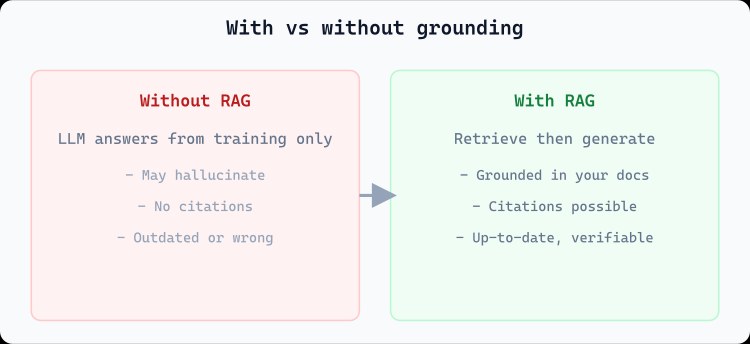
Without grounding, the model draws only from its training data. That leads to outdated facts, invented details, and no way to verify. In business settings—policy questions, support, internal knowledge—that's unacceptable. Users need answers they can trust and trace.
How to ground
RAG is the most common way: retrieve relevant passages and put them in the prompt. Other options include tool use (calling APIs or databases) and structured data pipelines. The goal is the same: tie the model's output to a known source.
What grounding does not fix
Grounding improves reliability but does not guarantee correctness. The source data can be wrong or outdated. Retrieval can return irrelevant or incomplete chunks. The model can still misread or oversimplify the context. So grounding is a necessary layer for trustworthy AI, not a substitute for good data and evaluation.